Nafudakake 名札掛け is a Dojo Nameplate Board, which is a wooden nameplate board traditionally displayed in Japanese martial arts dojos. It holds individual plaques bearing the names of students and instructors, usually arranged according to rank, seniority, or position within the dojo. Beyond identifying members, the nafudakake represents the structure, continuity, and community of the school.
The individual nameplates are called nafuda (名札). Each is typically a narrow, rectangular piece of wood bearing a practitioner’s name, traditionally written vertically in Japanese characters.
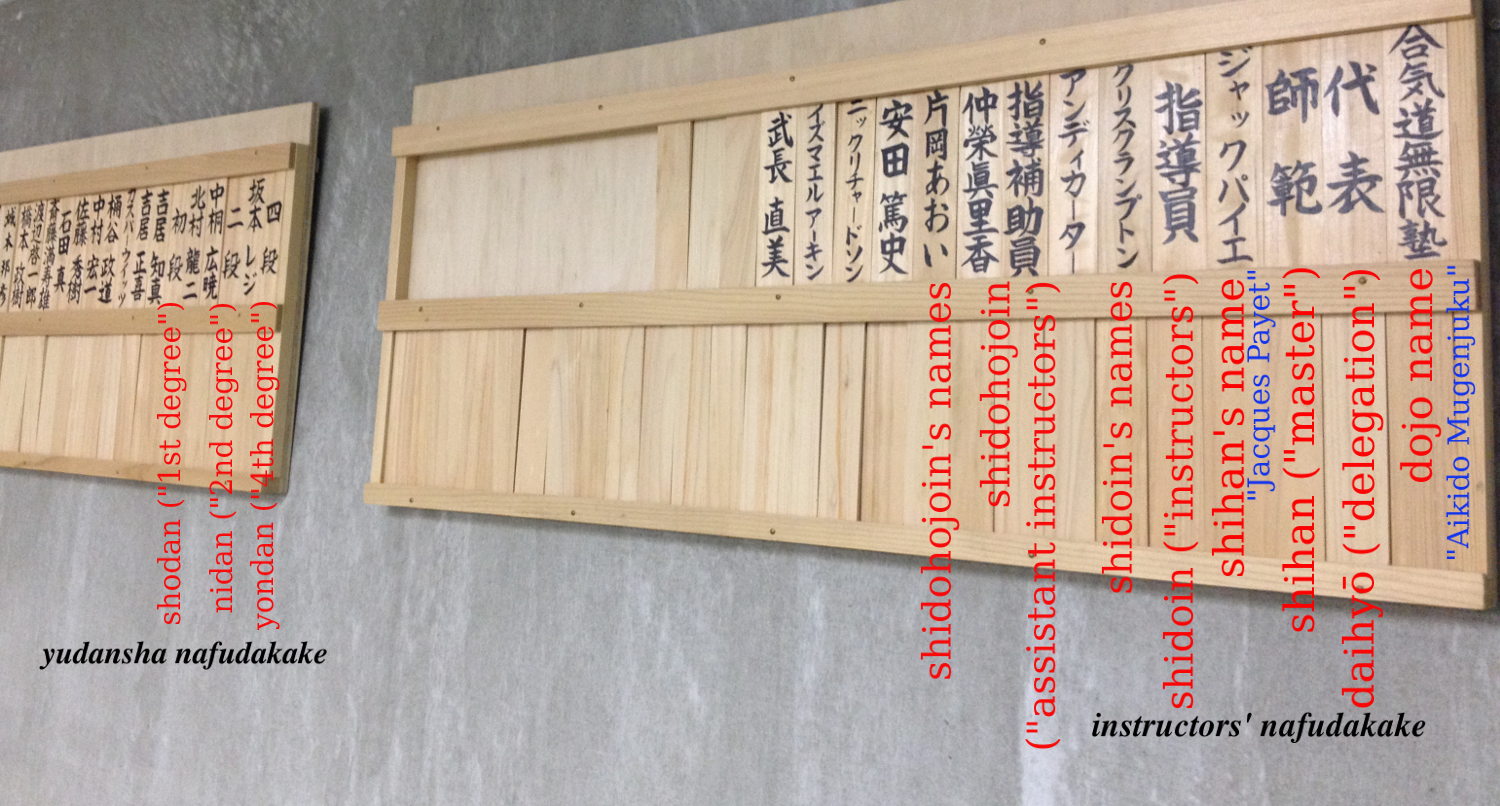
Arrangement of the Nameplates
The arrangement of a nafudakake varies from dojo to dojo. In many schools, instructors and senior practitioners occupy the most prominent positions, with other members grouped according to their grades or seniority.
Some boards distinguish between yūdansha (有段者), practitioners holding danDan 段 is a graded level or stage of advancement in Japanese arts, especially martial arts. More ranks, and mudansha (無段者), practitioners who have not yet attained a danDan 段 is a graded level or stage of advancement in Japanese arts, especially martial arts. More rank. Others display separate sections for instructors, adult students, children, or particular training groups.
As a practitioner advances in rank, the nameplate may be moved to a new position on the board. The arrangement therefore provides a visible record of progress within the school.
There is no single arrangement used by every Japanese martial art or dojo.
Construction
Traditional nafudakake are generally constructed from wood, with individual nameplates fitted into horizontal grooves or held on pegs or hooks. The plaques may be painted, engraved, or inscribed with brush calligraphy.
Some are simple, functional boards, while others are carefully crafted pieces of woodworking. Larger dojos may have elaborate displays accommodating dozens or even hundreds of names.
Significance in the Dojo
The nafudakake serves a purpose beyond recording rank. It recognizes each practitioner’s place within the dojo and provides a visible connection between students, teachers, and the wider martial arts community.
In some schools, the plaques of former instructors, senior students, or deceased members are preserved as part of the dojo’s history. In others, only currently active members are displayed. A nafudakake can therefore serve as both a record of membership and an expression of the dojo’s continuing tradition.
Although especially familiar in Japanese martial arts such as kendō, jūdō, karate, and aikidōAikidō is a Japanese martial art that blends with an opponent’s force to control and throw them without relying on strength. More, nameplate displays are not exclusive to martial arts and can also be found in other Japanese organizations and traditional activities.
Translation and Kanji
Related Terms
- Nafuda 名札 — Nameplate or name tag; the individual plaque displayed on a nafudakake.
- Dōjō 道場 — Place of training; the hall or school in which a Japanese martial art is practiced.
- Senpai 先輩 — Senior member or practitioner with greater experience or seniority.
- Kōhai 後輩 — Junior member or practitioner with less experience or seniority.
- Yūdansha 有段者 — A practitioner holding a danDan 段 is a graded level or stage of advancement in Japanese arts, especially martial arts. More rank.
- Mudansha 無段者 — A practitioner who has not attained a danDan 段 is a graded level or stage of advancement in Japanese arts, especially martial arts. More rank.